


What we do next for our economic recovery will shape our lives for decades to come
- The Beagle

- Jul 8, 2020
- 10 min read
By Jesse Rowan
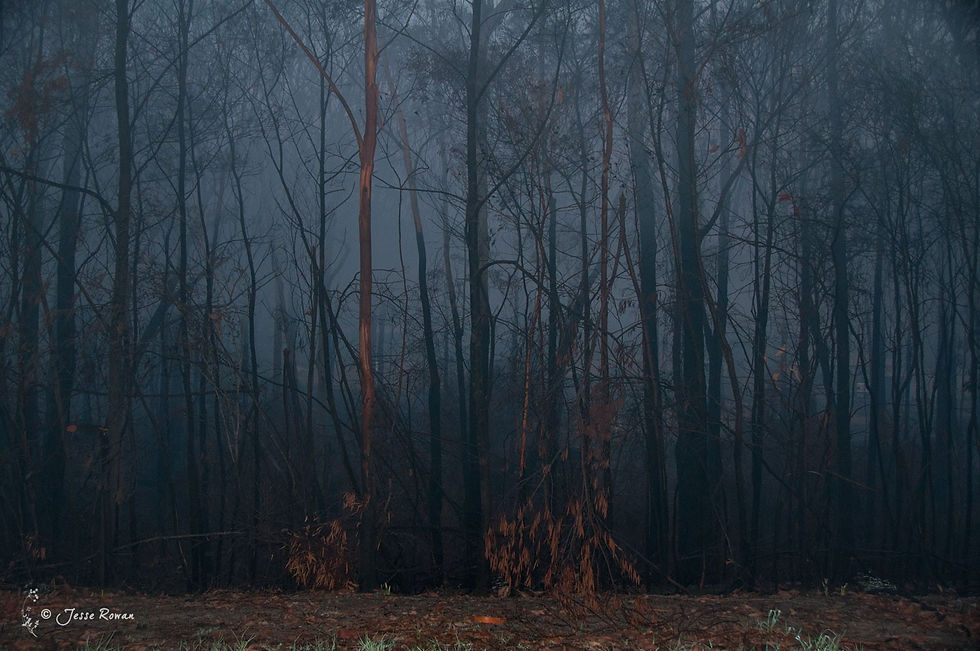
Pretty Point is a stark reminder of what we stand to lose if governments try to kickstart our economy with fossil fuels instead of clean renewables as the basis for investing in jobs and infrastructure: worsening fire seasons with more Catastrophic days and more days of higher temperatures.

Yesterday I took my morning walk there, noticing the trees burnt black, dead, with no signs of new shoots. How can this recover? This used to be a shady, green dreaming place, a beautiful walk through lush undergrowth full of birds… most of the green now is weeds.


Last week the NSW government released its Strategic Statement on Coal Exploration and Mining announcing more coal expansion and mining. Governments are approving the destruction of our communities while they ignore scientific evidence of the worsening impacts of climate change.
This lack of leadership fuels my sense of anger and powerlessness as I witness first hand the devastating impacts of climate change. I feel so absolutely abandoned by the people who are supposedly elected to protect everyday Australians, yet they refuse to listen and act on expert and scientific advice that has been presented clearly for decades.
While my family survived last season’s New Year's Eve fire, our future safety is at risk as our elected officials knowingly allow climate change to worsen. In Catastrophic fire conditions, we are told not to stay and defend our homes, but where can we go? No regional town or property is safe then, and even our cities are under threat. Bushfire smoke will cover much of the continent, affecting our health. If we all have to pack up and leave for many days or weeks in preparation for rising numbers of Catastrophic days, the costs to productivity will be enormous.

Six months after the Clyde Mountain bushfire raced towards our Malua Bay home, I still wake up in the middle of the night. In the early weeks it was out of fear for my family's safety, with bushfires still burning nearby. Now it’s a sense of grief for our sadly decimated environment, for our quiet, empty forests of burnt trees missing so many birds and animals, and despair about the dangerous future ahead keeps me waking, worried for our children’s future.
On New Year's Eve we had a detailed fire plan, with a tank, fire hoses and a petrol-driven fire pump, so we stayed to defend our home. Our children, aged 15, 17 and 22 stayed too, despite plans to evacuate them. Their options had closed quickly with road closures and impending fires along the coast and not-very-safe ‘safer places’. With our fire hoses joined together and the help of a few neighbours, we managed to keep the fire away from homes in our street.
Watching as the flames first appeared in the dense smoke over the ridge, knowing our fire brigades were elsewhere and our communications were cut caused a sickening feeling of fear. The kids wanted to evacuate right then, but we followed our fire plan and all stayed. As we watched the bushfire burning towards us through the forest from three directions joining in a semi-circle, we felt helpless with our mops and buckets and even our fire hoses.

Luckily the steep slope down towards our street slowed the fire as it came closer, and then the Southerly change hit. At first the wind was strong and erratic, but then it drove the fire back on itself, leaving burning logs, stumps and bushes. The forest adjacent to our home continued to burn for a few days and nights, so I woke every hour to check that the flames in the bush weren't coming closer or spreading up tree trunks. We heard many crashes as huge trees burnt through and fell down over the next weeks. Many times in those first few nights I woke my partner so we could drag the fire hoses down to the forest to bring the flames back under control until later when our fire brigade and a water-bombing helicopter helped douse where our hoses couldn’t reach.

With the fires near us out, I drove around our community checking for further fire threats and taking photos of the devastation before it was cleaned up.
I wanted people to see what had happened to our community, to see the decimation caused by climate-driven bushfires so that at last our leaders would act to keep us safe from even worse events.
During the long weeks when power infrastructure was ruined, I'd sit in my hot car on a hill to get signal, desperately scrolling through the news on my phone, hoping to see an announcement that the federal government would now commit to urgent action on climate change.
There were many articles from former fire chiefs, scientists, and other experts saying that climate change had fuelled these unprecedented bushfire conditions, and that digging up and burning fossil fuels like coal and gas was making it worse.
No announcement on climate action came. I was stunned that the federal government could ignore the unprecedented scale of bushfire devastation and death across Australia and continue with fossil fuels ‘business as usual’. They excused Australia's emissions as too small to matter - when in reality, we are a major polluter and fossil fuel exporter. New coal and gas projects like the Adani mine and a gas facility in Narrabri were approved, and the NSW government is even risking mining under Sydney’s water catchment when vital water supplies should be carefully protected.
This is our second bushfire; we’ve been through this before during the 2003 Canberra firestorm. Ordered by police to evacuate even after the main fire front had passed, I drove through flames with my babies, then 10 months and five years old, while my partner stayed to defend our home. Driving in pitch black smoke with flames along both sides of the road, showers of embers whirling and traffic lights dead, ours was the only car on the road. It felt like Armageddon as we came out of the dense smoke to Woden, strangely surreal as shoppers were going about their day, unaware of the disaster striking the outer suburbs of Canberra.
We moved to Malua Bay a couple of years after the Canberra firestorm, in search of green nature spaces for our children, which had not regenerated much since the fire as Canberra rainfall reduced and temperatures continued to rise.
Here in Malua Bay I joined the local Rural Fire Brigade to feel safer and more prepared for bushfires. Seeing the need for more members, I started our brigade’s web page and helped write a newsletter for our brigade to to attract new members and inform our local community. It’s great to see the brigade’s Facebook page now too - a welcome source of communication for our community during the power failures.
I stopped active duty after a tall spotted gum tree almost fell on me during a hazard-reduction - the second time this had happened. Unable to face the thought of my kids, then in primary school, losing their mother on the fireground, I became inactive.
My kids are young adults now, and they feel doubtful that the federal government will act with integrity on climate change. They introduced me to Juice Media’s Honest Government Ads - and we all laugh at our country’s plight, but feel awful facing the simple, stark truth that our elected representatives are not representing ordinary Australians to keep them safe and healthy.
My younger son even quit school recently, seeing no point in learning for a future that looks scary due to climate change.
My source of hope is for my children to know that I tried my hardest to fight for their future. By taking democratic action, I am maintaining hope that enough voices will bring about the change that’s needed for governments to act, and modelling for them their democratic rights.

Since Greta Thunberg first inspired the school strikes, I joined them in solidarity, marching in the streets of Canberra as well as in the Eurobodalla. Since the fires I’ve delivered handwritten and heartfelt letters to my local member, Andrew Constance, but have had no reply at all. I’ve written to politicians at all levels of government, including our local council, asking them to take more urgent and effective action to keep us safe from the looming impacts of worsening climate heating. I join local climate action groups for public events, like 350.org, taking wheelbarrows of burnt stuff from Parliament House to the Coal Lobby to present them with an invoice for their estimated damages to our nation.

I will continue to act along with thousands of other Australians who dread worsening future fire seasons and economic consequences of climate catastrophe much worse than the Covid-19 epidemic.

Seeing how our political system works has been an eye-opener for me. The fact that the powerful coal lobby is within walking distance of Parliament House and is one of the biggest donors to election campaigns seems to be a blatant conflict of interest for politicians. I find it hard to respect the integrity of politicians who refuse to be subjected to adequate and fair processes of investigation into corruption to show all sources of political funding and conflicts of interest. Instead of acting for the best interests of ordinary citizens, governments appear to make their decisions along party lines and for political gains and profits for the few large and powerful companies that can afford to lobby.
Across the world I’m seeing signs of hope that other governments are at last committing to lower emissions and moving to renewables. Over 1000 climate lawsuits have commenced, and in December 2019 the Supreme Court of the Netherlands ordered its government to cut that nation’s greenhouse gas emissions by 25 percent from 1990 levels by the end of 2020.
According to the Chief Justice, Kees Streefkerk, because of climate change “the lives, well-being and living circumstances of many people around the world, including in the Netherlands, are being threatened.”
This decision supported an original Hague District Court decision of 2015 which stated that ‘the possibility of damages to current and future generations was so great and concrete that, given its duty of care, “the state must make an adequate contribution, greater than its current contribution, to prevent hazardous climate change.”’
I’m also heartened to hear that astute world banks, many businesses and other investors are divesting fossil fuels investments while they can, for fear of being left with stranded assets as governments across the world turn to renewables for their economic recovery, which expert scientists and economists are advising. Clean and safe renewable energy sources are now readily available and becoming cheaper and more popular.
Every day the media presents more scientific evidence of the escalation of climate change. It’s easy to lose hope in the face of so much growing evidence that scientific predictions are actually happening now, and at a faster rate than scientists predicted. ‘We are running out of time to act’ is the most important message I’m seeing. It helps to know that every day, more Australians are calling for climate action, and that there are already solutions available to bring down emissions that will help our economy recover.
These include phasing out fossil fuels immediately and investing in large-scale renewable energy and battery storage, along with land rehabilitation and reforestation to restore our eco-system.
Investing in clean energy projects can solve both the post-COVID-19 economic crisis while tackling the even more serious climate crisis. We can create thousands of safe, stable jobs in renewables, reset our economy, strengthen regional communities, and ensure a safer future for our children and grandchildren.
The billions of dollars in the post-Covid-19 economic stimulus are a unique opportunity (perhaps our last) to make a lasting impact on our emissions while investing in infrastructure and jobs that will bring us a better, cleaner and safer future. Politicians cannot afford to waste this opportunity by approving more fossil fuels projects which will make bushfires and other climate-driven disasters even worse.
As the world invests in renewables which are cheaper and safer, Australia’s investments in fossil fuels will become worthless. The canary in the coalmine will have died for nothing.
Just like the cigarette companies who knew the impacts of their products, so too our politicians have been warned by our scientists and experts of the effects of fossil fuels on climate change. To continue to fund our destruction is immoral.
Governments at all levels have a responsibility to keep us all safe. Australia’s political leaders have shown us that they are willing to listen to the experts and scientists and act for the safety of all Australians during the Covid-19 pandemic. The climate crisis is already affecting us all - our safety, health, our psychological well-being, our environment and animals. Climate change presents a far greater threat to our safety than Covid-19, terrorists, war, or economic depression. It affects our quality of life, our health and our survival, and the costs of not acting now will far outweigh the consequences for our economy as climate heating escalates.

Australia has been listening to scientists and health experts and has managed to avoid the health disaster we’ve seen in other countries. It’s essential that our leaders to heed the scientists and experts on climate change and respond to this even greater emergency while we still have time to keep us safer.
What we do next for our economic recovery will shape our lives for decades to come. Investment is essential to lift us out of this economic crisis: at the same time we should make this an opportunity to improve as much as we can, to get as much bang for our buck as possible.
Eden-Monaro voters had an important opportunity to have a say in how our economy is kick-started, by voting for a candidate who supports urgent action on climate change and a people-centred approach to investing on infrastructure that will improve everyone’s lives. We can’t afford our children’s future to go up in smoke by continuing to invest in fossil fuels.
Fiona Kotvojs, the Liberal candidate, downplayed the human contribution to global heating, preferring to focus on managing fuel loads instead, and did not acknowledge the overwhelming scientific evidence against this view. Little doubt Ms Kotvojs was constrained by the coalition’s ineffectual climate change policy, in particular their continued investment in fossil fuels despite the scientific acceptance that burning fossil fuels has a direct impact of worsening climate change.
Though a vote for the Greens or Labor would not have gained a majority in Federal parliament, voting this way for the many who did sent a powerful message to leaders that we want action on climate change NOW: we don’t want a fossil-fuel led economic ‘recovery’ which will keep us on the path to escalating bushfires and environmental destruction. The cost of not acting on the climate crisis will be far worse than the cost of acting now.
We want to invest in people, and infrastructure that will set us up for the next decades to make our communities stronger and more resilient.
If we put people first rather than profits for the relative few, we can use this massive investment opportunity to transition to a clean energy economy, creating hundreds of thousands of good jobs, making sure everyone has an income they can live on and a safer future with hope for our young people.